
Call Us Today: 1 661-404-7370 Mon-Fridday 9am to 5pm Pacific Standard Time
Off the Books?
Off-the-Books Employees or Contractors? No Records? We’re Here to Help — the Right Way.
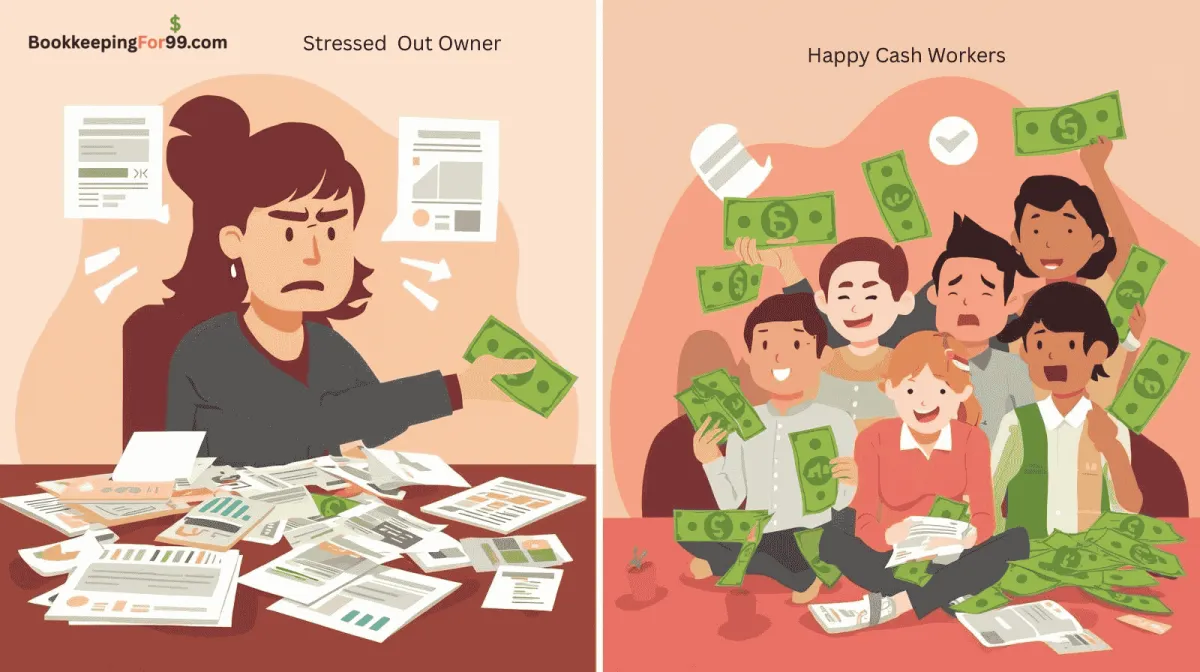
If You Are Off the Books, It’s Not Too Late to Get Back on Track
If you are a small business owner who is unsure whether your records are “good enough,” have been operating informally, have paid contractors or employees off the books, have not kept proper records of business transactions, or feel overwhelmed by bookkeeping requirements, this information is for you.
We are not here to judge how you operated in the past. Many businesses start informally and evolve over time. What matters is understanding what “off the books” really means, how it can hurt your business, what is actually required to become compliant, and how to move forward in a clean, practical way.
While most bookkeepers will not even discuss bookkeeping with a company operating off the books, BookkeepingFor99.com will guide you in getting back on track so that, going forward, your business is protected.
Reading this page first will help you understand:
✔ Whether your current setup is workable
✔ What changes may be required before bookkeeping can begin
✔ What we can help with — and what we cannot
What “Off the Books” Really Means (And Why It’s Risky)
In most cases being “off the books” it simply means:
✖ Income and expenses are not being tracked properly
✖ Personal and business activity is mixed together
✖ You have off the books employees or contractors
✖ Receipts and documentation are missing or incomplete
✖ Likely you haven't been filing business taxes
✖ Records cannot be supported if questioned
Risks of Operating Without Proper Records or “Off the Books” Practices:
✖ You don’t really know if you’re profitable
✖ Your numbers can’t be relied on for financial or legal decisions
✖ Banks, lenders, and partners won’t trust your reports
✖ Audits become much harder to handle
✖ You may not be able to legally transfer the business to a family member
✖ You may not be able to legally sell the business
✖ Without proper records, insurance claims can be denied or reduced.
✖ Missing records must be reconstructed if you get audited
✖ Deductions are missed if you file business taxes
✖ Tax return or bookkeeping costs increase
✖ Expenses may not be accepted by the IRS
✖ Additional taxes, penalties, and interest can apply
✖ Potential buyers will need clean books
✖ Value cannot be proven without proper bookkeeping records
What Getting Legit Actually Requires (And What It Does NOT)
Many small business owners delay getting organized because they believe compliance requires forming an LLC, hiring lawyers, or completing complex registrations. In most cases, that is not true.
If you operate a business by yourself, you are automatically considered a sole proprietorship. You do not need to form an LLC or corporation just to start bookkeeping.
You do not need:
✖ An LLC or corporation
✖ A registered business name in every case
✖ Expensive legal setup
You DO Need (This Is Required)
In most states, when someone starts a business on their own, they are automatically considered a sole proprietor. You do not need a formal registration to start the business. However, once the business has started, certain steps must be taken before legitimate bookkeeping can begin.
To begin legitimate bookkeeping, you must have the following in place or be committed to these steps:
✔ Step 1. An EIN (Employer Identification Number), which is free from the IRS
✔ Step 2. A DBA or local business registration only if your business name is different from your legal name
✔ Step 3. A business bank account used only for business (bring your EIN and DBA from Steps 1 and 2, if applicable, when opening the account)
✔ Step 4. A commitment to use the business bank account and business debit and/or credit card for all business-related transactions going forward
✔ Step 5. A commitment to never use the business account or business debit/credit card for personal expenses, and vice versa
✔ Step 6. Even if a client pays in cash, all cash must be deposited into the business checking account before being used for any purpose, including personal expenses
✔ Step 7. You must properly categorize your labor as employees or contractors and complete the required documents
Off the Book Employees & Contractors: Can Be a Major Issue
Many small businesses that operate off the books and pay their employees or contractors cash can face a major issue when they want to go legitimate and record their labor cost by issuing W2s or 1099s. Many employees and contractors insist on remaining off the books or threaten to quit.
As an employer you must determine what is more important to you, the future of your business or the labor that does not see what is best for you and your business. It is a very difficult decision to make because in many cases the such labor is provided by friends, family, and skilled people who are willing to work for less as long as they are off the books.
Unfortunately, you simply cannot do any bookkeeping or go legit if you do not properly classify your labor as employees or contractors and issue them W2s or 1099s accordingly.
No bookkeeper or accountant will be able to help you because not only it is illegal, it can also cost them their livelyhood.
Here is how you can determine how to classify your labor:
Employees typically:
Work set hours
Work at your location (unless remote workers)
Use your tools
Follow your instructions
Independent contractors typically:
Control how they work
Use their own tools
Set their own schedules
Work independently
We Are Here to Help You Get Back on Track, the Right Way!
If your past records are incomplete, and you have been operating your business off the books, but now you have decided to get back on track, you have two practical paths.
Option 1: Start From Where You Are - Today. You can start fresh today by putting proper systems in place and keeping clean records as described earler going forward.
Option 2: Fix All the Past Records Before Moving Forward. You can choose to clean up the past by reconstructing records, which takes more time and cost.
Most clients choose to start clean going forward and address the past separately.
Ready to Get Organized (No Pressure, Just Facts)
If you want honest guidance about your current situation, we’re here to help.
We’ll talk through:
✔ Where your records stand
✔ What needs to change
✔ Whether you want to do it yourself or have help
✔ No pressure.
✔ No judgment.
The Bank Statement Myth: Why Your Bank Statement Alone Will Not Save You If You Get Audited
Many business owners believe that having a business bank account is enough.
They assume that because every transaction appears on a bank statement, they are covered. This is a common misunderstanding. A bank statement shows where money went.
It does not show:
✖ What was purchased
✖ Why it was purchased
✖ Which job or customer it relates to
✖ How it should be categorized
✖ In an audit, a bank statement alone is not proof.
✖ Without receipts and documentation, tax deductions can be disallowed
even if the expense was legitimate. Which mean you pay more taxes.
The Receipt Nightmare: Why Most Small Businesses Are Not Audit-Ready
Most business owners who save receipts struggle with the same problems.
✖ Receipts are thrown into drawers or boxes to be organized later.
✖ Thermal paper fades over time.
✖ Details are forgotten.
✖ Receipts are damaged or lost.
✖ By the time records are needed, the information is incomplete.
✖ Paper receipts are not reliable long-term storage. Digital records are.
Must follow these 5 rules:
✔Scan every receipt immediately (tools: QuickBooks app, Expensify, phone camera)
✔Add a note while it's fresh (what, why, category)
✔ Keep business and personal separate (no exceptions)
✔Reconcile weekly (yourself or hire us)
✔ Review monthly reports (P&L, Balance Sheet, Cash Flow)

Free Tools To Grow Your Interpreting Practice
Free Marketing Toolkit
Multi-Source Inbox
Forms and Survey Builder
Website and Funnel Builder
Blog Builder
Calendar & Scheduling Builder
Social Media Poster & Scheduler
Mass Email Mailer & Scheduler
Smart Chat - Website to SMS
Reputation Management
Contact Information/Database
Sell Course and Video Membership
Prospects to Clients - Pipeline
Visit us on Linkedin:

Ways to Contact Us:
1 888-515-8262
Mon-Fri 9am-5pm Pacific Standard Time
U.S.-based bookkeeping built for ASL Interpreters. Certified QuickBooks experts keeping your books clean and your tax preparer supported.
© Copyright 2020-2025. ASLBookeeping.com
Fully Owned And Operated By
Digital Ad Cast LLC.
All rights reserved